The structure and symbols of church interiors convey messages and ideas that are sometimes intentional and sometimes accidental.
Since about A.D. 700 churches have existed on the site of St. Emmeram in Regensburg, Bavaria. The current building includes chapels and crypts dating as far back as the 8th century. It has gone through the usual series of fires, reconstructions and modifications until the 18th century renovation of the nave and chancel in the Rococo style with further restoration from the 1950s and beyond.
I’ve always found the dense sculptures, paintings and adornment in Baroque and Rococo churches a bit overwhelming. Perhaps it is not so for everyone. While we were there, a priest sat in a back pew, focused not on the decoration but apparently in meditation or prayer. Some people respond differently. An American walking down the center aisle loudly exclaimed to his companion, “There’s a lot of money hanging on these walls.” The priest promptly looked up and shushed him. Thankfully the man was embarrassed and apologetic.

In Augsburg we visited two churches that took the opportunity this summer of 2025 to communicate their message non-traditionally and emphatically.
St. Peter am Perlach, Augsburg, aside from its notable bell tower currently covered in scaffolding, is a rather small church. Entering through a side door, this is the scene that confronted us.

My first confused thought was why the “anti-tank obstacles, aka Spanish Riders?” Fortunately there was a booklet to explain the installation. The ominous pieces are an artwork by Jannis Kounellis. Each obstacle is made of two steel I-beams that form a roman cross with a third welded at an angle as a support.
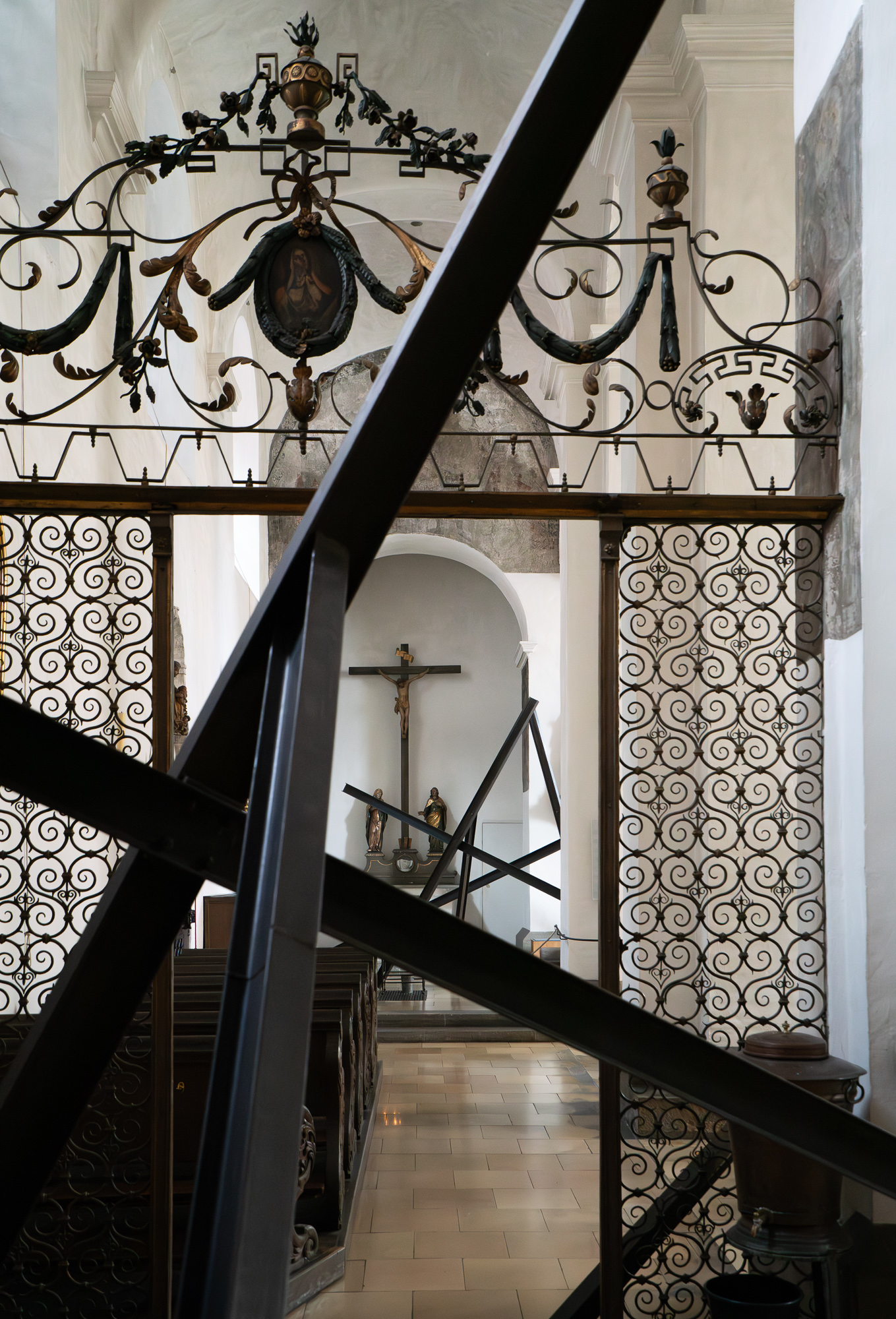
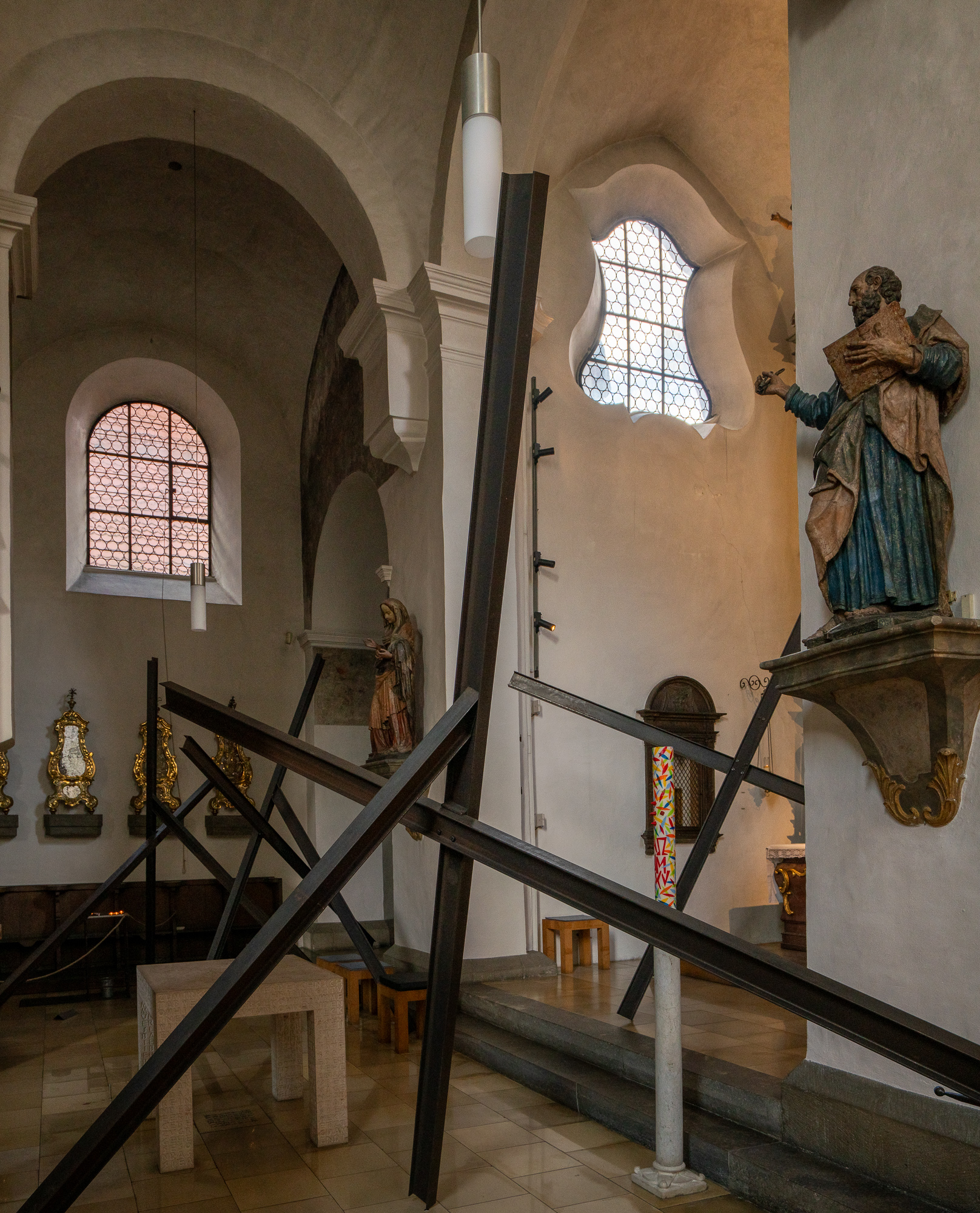
The arrangement of the pieces is intended to impede the progress of the priest, congregants and visitors and focus their attention on the cross as the central and preeminent message of the church.
The industrial, coarse construction so like implements of war is intended to link the suffering of Christ with the suffering of victims of warfare in the viewers mind, especially with respect to the war in Ukraine that is on the threshold of Western Europe.
The rector concludes his introduction to the booklet with this:
The Cross and Spanish Riders awaken us to the fact that
salvation is promised over all suffering.
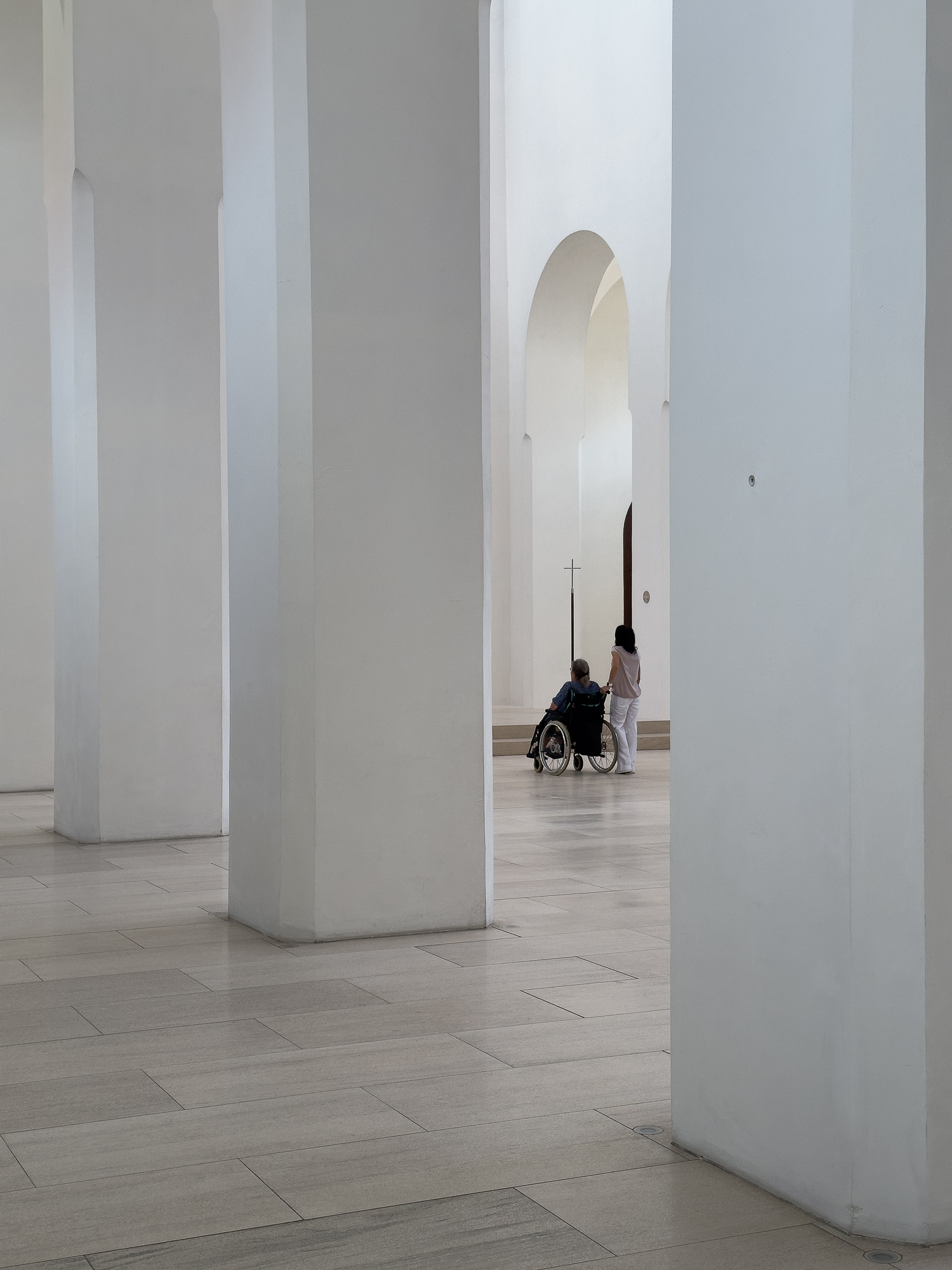
The second unusual church arrangement was just a block down the street at St. Moritz. The interior is minimalist to an extreme. There is no ornamentation, no color, no seating. One is drawn only to the central figure of Christ in a welcoming posture.

Fortunately a docent was waiting near the entrance to greet us and explain what we were seeing. Allied bombing in 1944 nearly completely destroyed the historical church on this site. The church was replaced with simpler structure by 1951. A complete renovation from 2010 to 2013 resulted in the current appearance. For this summer, the pews were removed with the idea of further eliminating distractions.
A banner in the foyer with the title “Nicht Nichts” (Not Nothing) extends an invitation to set aside the flood of sounds, words and images of the outside world and engage with the peace this empty building provides.






 Craig's Places